
Sustainability
-

- Sustainability
-
Procurement
Social
Basic approach and policy
In order to provide customers with products that can be used with peace of mind, it is essential
to build a supply chain that enables the stable procurement of high-quality and
price-competitive raw materials.
By gaining their long-term trust with suppliers through fair, impartial, and transparent
transactions, we will promote procurement activities that take into consideration resources, the
environment, and human rights, so that the entire supply chain will be able to grow
sustainably.
For the purpose of promoting responsible procurement across the entire supply chain, we have
established the “T.HASEGAWA Group Procurement Policy” and “T.HASEGAWA Group Supplier
Guidelines.” We request existing suppliers to submit a consent letter to our Supplier
Guidelines, and also require new suppliers to do the same at the start of any business
relationship.
T.HASEGAWA Procurement Policy
- 1.Legal compliance and ethical transactions
We will observe laws and social norms in each country and region and promote procurement activities with high ethical standards and social good sense together with suppliers.
- 2.Considerations for human rights
We will respect human rights in every situation and endeavor to ensure that no activities that may violate human rights are conducted across the entire supply chain so that there is no discrimination.
- 3.Considerations for the global environment
Together with all suppliers, we will conduct sustainable procurement activities that take into consideration global environmental protection with an awareness of reducing the environmental impact.
- 4.Mutual trust, co-existence, and prosperity with suppliers
We will respect the standpoint of counterparties based on mutual trust according to the principles of fair and open competition and seek to co-exist and achieve prosperity together with all of our business partners, including suppliers.
- 5.Safety, security, and customer success
We will conduct procurement activities aimed at realizing customer success, safety, and security by providing safe and quality products to customers and, in turn, consumers.
T.HASEGAWA Group Supplier Guidelines
For more details, please refer to the T.Hasegawa Group Supplier Guidelines (PDF) .
Governance and risk management
Raw material procurement is mainly promoted by the Procurement Division. The Risk Management
Committee is a Group-wide organization that is chaired by the CEO and consists of directors as
members. It manages and verifies procurement-related risks. The Procurement Division collects
risk information related to procurement and reports it to the Risk Management Committee.
Note that the Group does business with chemical manufacturers, flavor and fragrance
manufacturers in the same industry, food additive manufacturers, food manufacturers, trading
companies, contract manufacturers, and packaging material manufacturers.
In FY2025, the total number of suppliers that the Company had business with was around 400, with
a total number of 3,000 purchased items. The main breakdowns are flavor and fragrance raw
materials (natural and synthetic) and food (including food additives), which have the same
percentage. The ratio of imports to domestic procurement is 45:55, and our suppliers are located
in Japan, China, the United States, the European Union, the United Kingdom, India, Brazil,
Argentina, and other countries around the world. A distinctive characteristic of our suppliers
is that they engage in high-mix, low-volume production and offer raw materials with relatively
high unit prices.
Strategies
Increase in business opportunities
- Overseas local procurement and local production
Measures
- Implementation of global raw material procurement
- Investigation and development of alternative raw materials
- Sustainability survey and support for suppliers
Implementation of supplier assessment
To promote responsible procurement, the Group conducts supplier assessments related to human rights, labor, the environment, fair corporate activities, quality and safety, information security, supply chain, local communities, and corporate governance. In addition, when initiating new transactions, we request suppliers to sign a consent letter to the T.HASEGAWA Group Supplier Guidelines and conduct a supplier assessment using the CSR Procurement Self- Assessment Tool.
FY2025 survey
Survey format:
Questionnaire using the CSR Procurement Self-Assessment Tool
Target:
Top 152 suppliers by purchase amount, out of approximately 400 suppliers
Response rate:
98% (149 companies responded/152 companies surveyed)
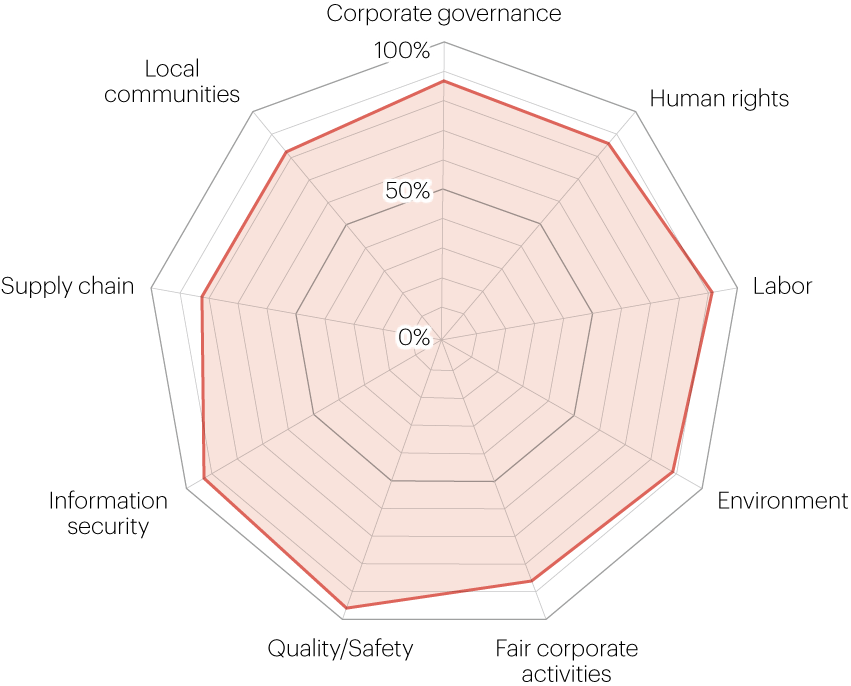
Trends, etc., based on the response
- Suppliers that score highly in corporate governance have built a sufficient CSR promotion system and tend to score high points overall.
- Even if they have not developed a CSR promotion system, the companies generally scored high points in quality and safety, which means they have effectively implemented quality management.
- Some suppliers that scored relatively high points had low scores in human rights and supply chain. Consequently, human rights and supply chain management can be considered to be future issues, even for companies that have developed a CSR system to some extent.
The response rate increased by 1 point compared to the previous year. While there were no major
changes in overall trends, improvements were observed in areas such as environment, information
security, and local communities.
Based on the questionnaire results, we understand that there were no suppliers with significant
risks related to environmental practices, child labor, or forced labor, nor any suppliers that
may pose risks to freedom of association or the right to collective bargaining.
Implementation of supplier monitoring
The Group has been conducting on-site audits of product safety and quality at several of its suppliers on an ongoing basis, and these audits also include checks on the environment, human rights, and occupational safety. Based on the audit results, we have determined that no violations were identified in the areas of environmental or social compliance. If any issues are found, we conduct additional audits to investigate the root cause, request the submission of a corrective action plan, and follow up with the supplier until the issues are fully resolved.
Plan for the future
We will further advance the supplier assessment, extract issues based on survey results, and cooperate with suppliers to solve the issues together, thereby solidifying the relations with suppliers and promoting sustainable procurement.
- We will continue to share the T.HASEGAWA Group Supplier Guidelines with more suppliers.
- We will continue to request suppliers in the supply chain to promote sustainability.
- We will continue to ask suppliers to respond using the CSR Procurement Self-Assessment Tool from the Global Compact Network Japan.
- We will request overseas subsidiaries to conduct assessments of local suppliers and promote dialogue with domestic and overseas suppliers.
- We began preparing for supplier engagement activities.
Procurement training
To promote awareness and understanding of the T.HASEGAWA Code of Conduct, the T.HASEGAWA Group Procurement Policy, and the T.HASEGAWA Group Supplier Guidelines, we regularly conduct training sessions for members of the procurement division.
Supplier engagement
To ensure that our suppliers understand and put into practice the T.HASEGAWA Group’s approach to responsible sourcing, we actively promote awareness of the T.HASEGAWA Group Procurement Policy and the T.HASEGAWA Group Supplier Guidelines. Specifically, we request both new and existing suppliers to sign a consent letter to the Supplier Guidelines. Through these efforts, we strive to reduce negative environmental and social impacts within our supply chain.
Procurement of certified raw materials
Depending on the needs of our customers, we purchase part of our raw materials from farms certified by Japan Good Agricultural Practices (JGAP), ASIAGAP, and Rainforest Alliance.
Procurement of perilla oil
We promote the active use of distinctive flavor and fragrance raw materials in Japan as part of our challenge to develop uniquely Japanese flavors. To procure perilla oil, which is an important flavor and fragrance raw material, we collaborate with a producers’ association, as described below, to support stable production in terms of quality and quantity, as well as to ensure business continuation.
Provision of seeds:
We provide seeds to producers every year to ensure the stable quality and yield of perilla oil. With the cooperation of seed and seedling producers, we confirm the conditions of production sites.
Technical support:
To improve productivity, we dispatch researchers and engineers to give advice and support on production improvement and equipment modification.
Quality improvement support:
We dispatch researchers to provide training and support for quality inspection procedures that are difficult to learn only from a producers’ association.
Supply of packaging, etc.:
We provide containers for filling and packaging materials to a producers’ association.
Business continuity:
We promote long-term procurement planning that avoids significant fluctuations in cultivation areas to ensure stable income for producers.
Indicators and targets
The T.HASEGAWA has set targets for supplier assessments and is working to improve its supply
chain management. In Scope 3, we are committed to ensuring that suppliers accounting for 80% of
the GHG emissions from the raw materials and auxiliary materials that we procure will have set
science-based targets by 2029.
In FY2025, the supplier assessment implementation rate was 90% based on procurement value.
For more details, please refer to the
T.HASEGAWA Group ESG Data Book (PDF).