
Sustainability
-

- Sustainability
-
Biodiversity
Basic approach and policy
Damage to biodiversity and natural capital makes it difficult to ensure a stable supply of
natural raw materials and to maintain their quality. At the same time, it also poses various
risks to business activities, such as stricter regulations on ecosystem conservation. On the
other hand, amid growing attention to biodiversity and rising environmental awareness, new
business opportunities are also expected to emerge, including increased demand for sustainably
procured raw materials and environmentally friendly products, as well as an enhanced corporate
reputation through initiatives that help conserve natural capital.
In response to these anticipated environmental changes surrounding biodiversity, the Group aims
to solve global challenges by leveraging a wide range of technologies that go beyond flavors and
fragrances, thereby creating new value and inspiration and contributing to richer and more
fulfilling lives.
The Group strives to disclose information in line with the recommendations of the Taskforce on
Nature-related Financial Disclosures (TNFD).
For more details, please see “TCFD and TNFD Disclosure of T.HASEGAWA Group (PDF)”.
TNFD general requirements
The following outlines the general requirements based on the disclosure recommendations of the TNFD.
Application of materiality
In assessing nature-related risks and opportunities, we adopt a single materiality approach, consistent with company-wide risk management and TCFD disclosures, to evaluate the impact of natural capital on our business.
Scope of disclosure
The scope of this disclosure analysis covers the Group’s main business segment of the flavor and fragrance business (production and sales of flavors and fragrances). The production of flavors and fragrances uses a wide variety of raw materials, including petroleum-derived products, but for the upstream value chain analysis, we included major plant-derived raw materials such as vanilla, coffee, and lemon, which are relatively more dependent on and influenced by natural capital.

Regions with nature-related issues
We identified the locations of raw material production sites, procurement sites within the scope of analysis, and all Group facilities, and assessed whether they fall within the priority areas defined by the TNFD. For procurement sites where precise location data could not be confirmed at this stage, we assessed approximate locations and ranges using publicly available information. Due to the difficulty of obtaining data, we have not yet identified specific locations for logistics and downstream areas of the value chain.
Integration with other sustainability-related disclosures
Risks and opportunities related to climate change and biodiversity are organized in an integrated manner in this disclosure.
Target period to be considered
For the assessment of risks and opportunities, we have established the following timeframes: short term (immediate future), medium term (2030), and long term (2050).
Engagement with indigenous peoples, local communities, and affected stakeholders
The Group engages with stakeholders through supplier assessments and other activities in accordance with the T.HASEGAWA Group Procurement Policy. For certain raw materials, we also visit production sites overseas to engage in direct communication with producers and suppliers.
Governance and risk management
Governance
Climate- and nature-related risks and opportunities are managed through the Group’s
sustainability promotion system. The CEO is responsible for sustainability matters, including
climate change and biodiversity.
For more details, please refer to “Sustainability Promotion System”.
Risk management system
The Group has established a Risk Management Committee, chaired by the CEO, as a cross-group
organization to analyze and manage risks and consider countermeasures. Climate change and
nature-related risks and opportunities affecting the Group’s business are identified and
assessed through an analysis based on the LEAP approach as indicated by the TNFD. The identified
and assessed climate change and nature-related risks and opportunities, as well as other risks,
are reported to the Risk Management Committee and the Board of Directors.
For more details, please refer to “Risk Management”.
Nature-related stakeholder engagement
With respect to human rights policies and engagement activities related to the assessment and management of nature-related dependencies, impacts, risks, and opportunities, as required under the TNFD disclosure recommendations, the Group promotes supplier engagement based on the T.HASEGAWA Group Procurement Policy. We require our suppliers to respect human rights, and we engage with stakeholders through supplier assessments and other initiatives. In addition, for certain raw materials, we visit production sites overseas to engage in direct communication with producers and suppliers.
Strategies
Scenario and LEAP analysis
The Group has been conducting integrated disclosure by adding the content of the TNFD-based nature-related risk analysis to its existing TCFD-based climate change risk analysis. In the analysis, the climate change component is included in the scope of the TNFD disclosure recommendations, so the analysis is conducted based on scenarios in accordance with the LEAP approach as indicated in the TNFD.
Locate: Discovering contact with nature
We identified and assessed the locations of raw material production sites, procurement sites, and Group sites, and confirmed the locations of sites relevant to our business. We also evaluated the confirmed locations based on TNFD’s LEAP approach and identified priority areas to be considered.
- Northeastern Madagascar, where vanilla is grown, is located in an area of high biodiversity importance.
- Some of the lemons used by the Group are grown in Spain and Italy, both of which are water-stressed areas.
Evaluate: Diagnosis of dependence and impact
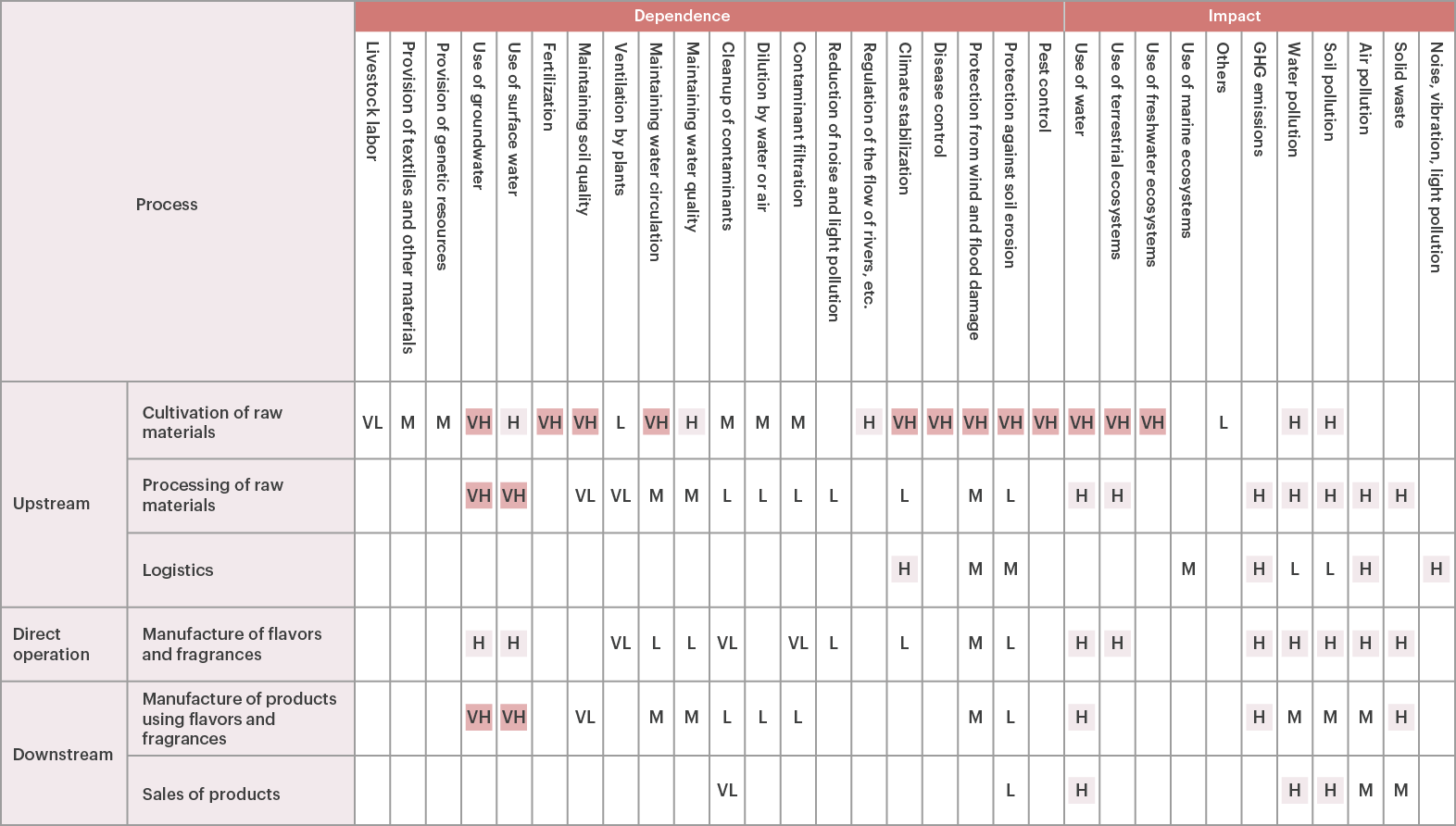
Using ENCORE, a tool for identifying and assessing the dependence and impact of business activities on nature, we identified the nature and magnitude of dependence and impact related to each process in the value chain and summarized them in a heat map.
Heat map of dependence/impact Note: VH: Very High, H: High, M: Medium, L: Low, VL: Very Low
Assess: Assessment of risk and opportunity
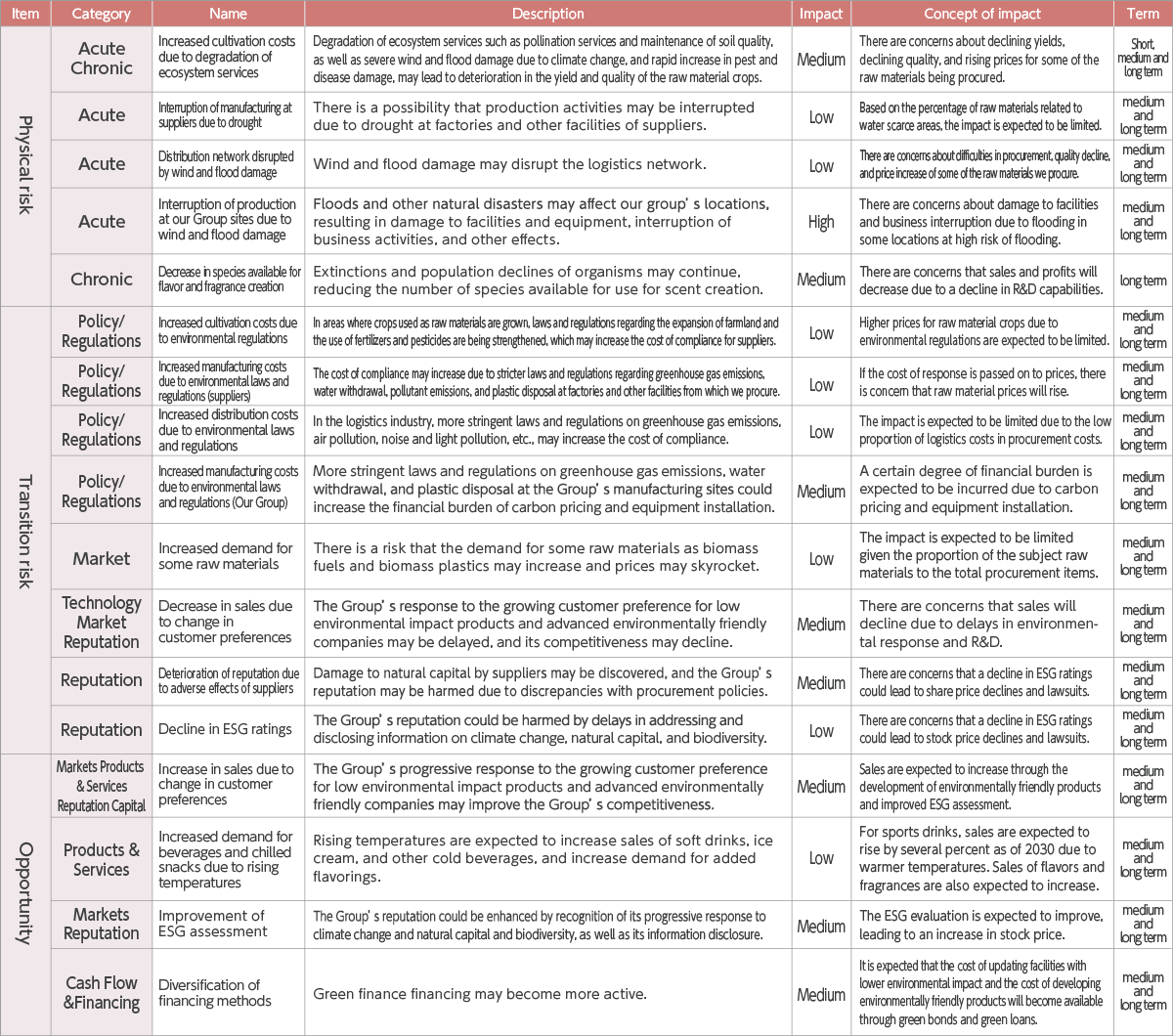
Based on the analysis conducted through the “Locate” and “Evaluate” phases, we identified risks
and opportunities and assessed their potential impact on the Group. For physical risks, we
carried out evaluations not only under a 4°C climate change scenario but also under conditions
assuming a loss of natural capital and a decline in ecosystem services. For transition risks, we
conducted evaluations under scenarios in which decarbonization is achieved (i.e., below 1.5°C or
2°C), as well as under scenarios where society shifts towards protecting natural capital. As for
opportunities, in addition to the opportunity categories outlined by the TNFD, we also
considered physical opportunities identified during our climate risk analysis - specifically
those arising under a 4°C scenario.
The Group aims to contribute to a more enriched society and achieve sustainable growth by
capturing business opportunities through innovation driven by the power of flavor and fragrance
creation, while thoroughly managing risks associated with these challenges and opportunities.
Main risks and opportunities
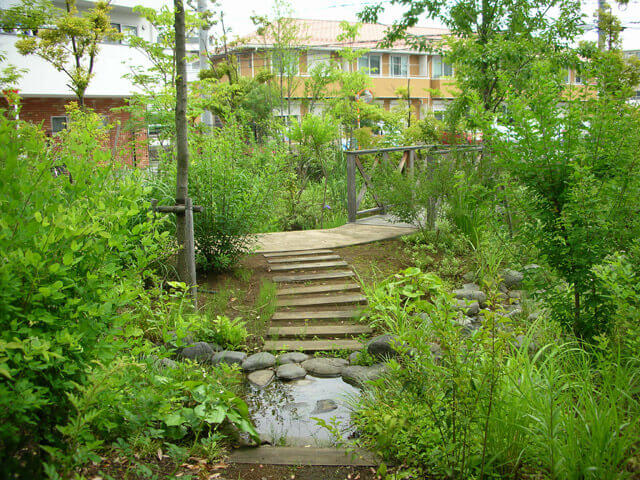
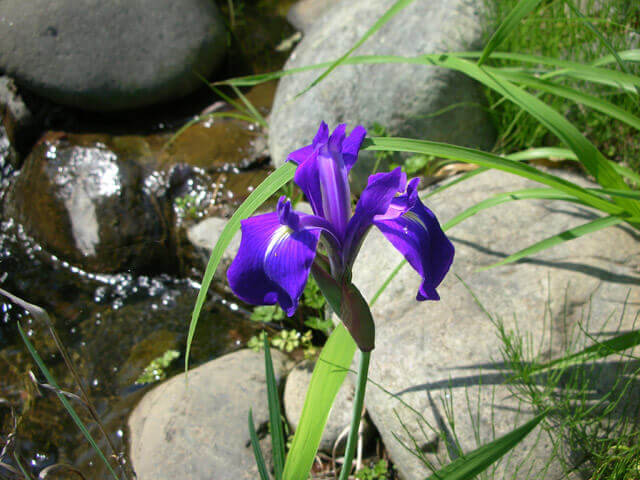
Establishment of a biotope in the R&D Center
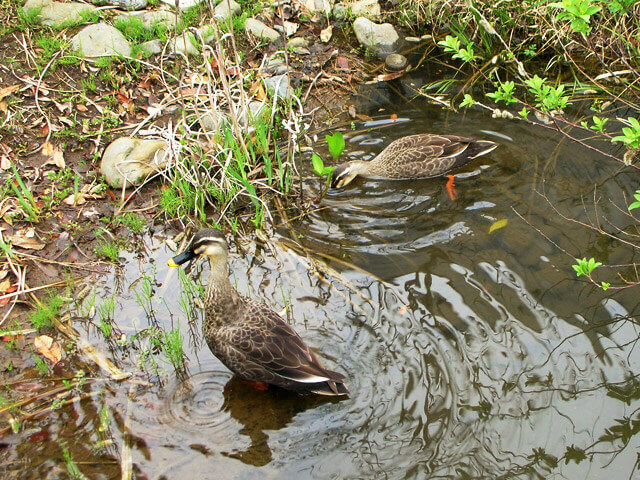
A biotope featuring mainly native plant species, along with a pond and stream, has been established on the R&D Center premises. It serves as a habitat for birds, amphibians, aquatic insects, and other local wildlife.
For more details on additional initiatives,“Environmental Management” , “Climate Change” , “Pollution & Waste” , “Water Resources” and “Procurement”.
Indicators and targets
Our Group in Japan has established indicators for spatial footprint, green areas, and related
factors, and is addressing climate change and biodiversity issues.
For more details, please refer to the
T.HASEGAWA Group ESG Data Book (PDF)