
Sustainability
-

- Sustainability
-
Compliance
Governance
Basic approach and policy
The Group regards compliance as one of the most important issues in corporate activities. We have prescribed the compliance rules and the T.HASEGAWA Corporate Code of Conduct to ensure that the execution of duties by all directors and all employees complies with laws and the Articles of Incorporation, as well as to fulfill the social responsibilities of a company and disseminate them to all directors and employees as part of efforts to ensure compliance.
Establishment of a policy on bribery and corruption
We support the ten principles of “Human Rights, Labour, Environment and Anti-Corruption” outlined in the UN Global Compact and have established the T.HASEGAWA Group Policy on Bribery and Corruption. The T.HASEGAWA Group Policy on Bribery and Corruption is reviewed at the Compliance Committee meeting held every September and is reported to and supervised by the Board of Directors, along with the status of internal controls and deliberations by the Committee. T.HASEGAWA will continue to promote responsible management for all stakeholders in order to create a sustainable world.
T.HASEGAWA Group Policy on Bribery and Corruption
In recognition of the fact that corruption of any kind, including bribery, is absolutely
unacceptable in the conduct of fair and equitable business activities, the T.HASEGAWA Group
established the following basic policy to ensure that our business activities comply with
the laws and regulations of the countries and regions in which we operate.
The Basic Policy prohibits any form of corruption, including the offering of money, favors,
or other benefits to local or foreign public officials or business partners for the purpose
of seeking unfair advantage; bribery, including excessive entertainment and the giving or
receiving of gifts; and unfair competition, including fraud, collusion, and cozy
relationships.
- The T.HASEGAWA Group observes all laws and corporate ethics related to bribery and corruption prevention applicable in Japan and overseas in accordance with the “Compliance with laws and regulations,” “Actions towards customers,” and “Relationships with suppliers” sections stipulated in the T.HASEGAWA employment regulations and the T.HASEGAWA Corporate Code of Conduct and does not allow any act of bribery or corruption.
- The T.HASEGAWA Group will never demand profits that can be gained only through bribery, corruption, or other similar means under any circumstances. We also request cooperation from all domestic and overseas business partners involved in our Group’s business to understand the aim of this policy fully and to never seek to serve the interests of the Group through such improper means.
- The T.HASEGAWA Group appoints the officer or the deputy officer in charge of internal management control as the chief supervisor for preventing bribery and corruption. We will work to improve the compliance system by implementing measures, including the provision of training to prevent bribery and corruption and the enhancement of the whistleblowing system.
*Corruption refers to any act of abusing one’s position or authority to gain an unfair advantage, including bribery, excessive entertainment, giving or receiving gifts, embezzlement, bid-rigging, collusion, and other forms of unfair competition, extortion, fraud, accounting irregularities, money laundering, and the like.
The above policy on bribery and corruption prevention was approved by the Group’s Board of Directors on November 28, 2024.
Our policy on experiments using human subjects
When conducting experiments using human subjects, including sensory evaluation and physiological response measurement, we obtain prior approval from the internal research ethics committee for human subjects based on our guidelines for conducting research involving human participants.
Approach to animal tests
The Group has a policy of not conducting animal testing in any research and development for
flavor and fragrance products and does not support any activities that involve animal
testing.
Upon requests from the administrative authorities, however, animal testing cannot be avoided in
some cases.
Establishment of a tax policy
The circumstances surrounding tax have become more complicated due to our global development, so the Group is working to strengthen tax governance to appropriately respond to tax risks, etc., in the countries and regions where we operate. As part of this effort, we have established the T.HASEGAWA Group Tax Policy with the aim of raising the awareness of all Group directors and employees on tax compliance.
T.HASEGAWA Group Tax Policy
Basic policy
The T.HASEGAWA Group observes laws and regulations in accordance with the T.HASEGAWA
Corporate Code of Conduct, fulfills its social responsibilities by properly performing tax
obligations in its operating countries and regions, and aims to continue improvin g its
corporate value.
- 1.Compliance with laws and regulations
The Group understands the legislative intent of tax-related laws and regulations in each country and region, and properly fulfills its tax obligations. We do not use tax incentives for programs that do not correspond to the actual business condition nor engage in tax avoidance using regions known as tax havens. In international transactions, we observe laws, regulations, and tax ordinances of countries and regions, as well as international taxation rules.
- 2.Ensuring transparency
The Group complies with relevant accounting and disclosure standards that should be complied with and works to disclose information to all stakeholders appropriately. Upon request from tax authorities, we will provide the necessary information and earn their trust. If any tax problem is pointed out, we will promptly implement improvement measures to prevent it from occurring again.
- 3.Minimizing tax risks
Through a correct understanding of tax systems, the Group aims to minimize tax risks and improve corporate value. For transactions in business activities whose tax interpretation is unclear, we receive advice from experts to fully examine them and confirm with tax authorities as necessary in an effort to reduce tax risks.
- 4.Tax governance
The Group receives advice from external experts regarding changes in the business environment and amendments to the tax system, etc., of each country and region to ensure that we accurately interpret tax laws and regulations. Each site responds to such changes in a timely and appropriate manner, and the Company has also established a system to share such information quickly.
The above tax policy was approved by the Group’s Board of Directors on November 28, 2024.
System
The T.HASEGAWA Group will continue its efforts to raise compliance awareness among each and every employee, while working in cooperation with Group companies to enhance and strengthen the overall compliance framework of the Group.
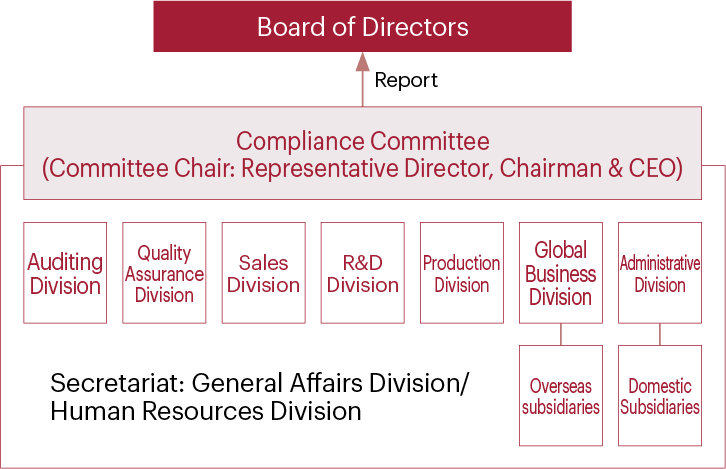
Compliance Committee
The Compliance Committee was established in accordance with compliance rules. It is chaired by
the Representative Director, Chairman & CEO, and includes directors as its members. The
Compliance Committee regularly investigates whether there are any illegal activities in the
Company for the purpose of preventing illegal activities, preventing the neglect or concealment
of potential illegal activities, and promptly identifying, discussing countermeasures for, and
correcting any illegal activities.
The Compliance Committee meets once a year to discuss important compliance-related matters and
report the results of comprehension tests.

Whistleblowing system
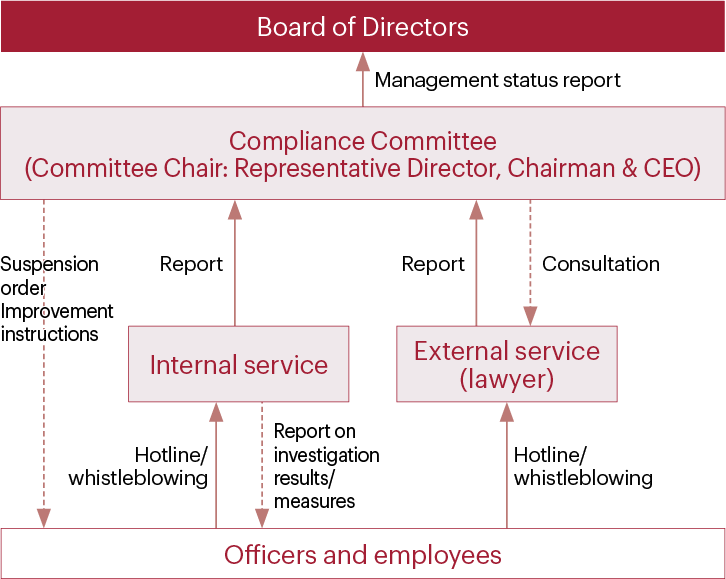
The Group has established a whistleblowing system to serve as a reporting channel for compliance
violations and harassment, including embezzlement, excessive entertainment, the exchange of
gifts, unfair trade practices, and all forms of bribery and corruption. In addition to multiple
internal whistleblowing hotlines, we have also set up an external reporting hotline managed by
an independent attorney, separate from executive management. We guarantee anonymity and
confidentiality in our operation of the whistleblowing system. Under no circumstances will
whistleblowers or those cooperating with investigations be subject to disadvantageous treatment
for reporting or seeking consultation in accordance with applicable laws and the Compliance
Regulations. In addition, the personal information of whistleblowers and any details that could
lead to their identification are strictly managed by the whistleblowing hotline. The Compliance
Committee and its Secretariat, in cooperation with the full-time auditors, are responsible for
monitoring whether whistleblowers receive any disadvantageous treatment. This is clearly stated
in the Compliance Regulations and thoroughly communicated to all directors and employees of the
Group.
The Compliance Committee reviews the status of internal reports received through both internal
and external whistleblowing hotlines at each Group company, conducts fact-finding
investigations, considers necessary countermeasures, and regularly reports on the operation of
the system to the Board of Directors.
Development and implementation of internal controls
In order to ensure the reliability of financial reporting, we have established the rules on internal controls to develop and implement internal controls pertaining to financial reporting and built a system to evaluate the effectiveness of the internal controls appropriately.
Strategies
Training and education on compliance
We distribute the T.HASEGAWA Corporate Code of Conduct to all directors and employees to
establish an environment where they can review it at any time. In addition, we strive to foster
awareness of compliance by providing ongoing training and education regarding laws and
regulations related to the execution of their duties at least once a year.
We conducted a compliance comprehension test for all employees, including directors, loaned
employees, and temporary employees, to confirm whether they understand the Code that requires
them to be sincere and maintain an ethical view. The content covers not only violations of laws
and regulations, but also the T.HASEGAWA Group’s Code of Conduct, which includes policies on
bribery and corruption prevention, and prohibition of insider trading, as well as the
whistleblowing system and harassment prevention measures.
To promote a greater understanding of internal control, we will provide training for new
employees, mid-career employees, and new managerial staff once a year.
Internal audit
Every year, the Internal Audit Division conducts internal audits of the Company’s operations based on the internal audit plan.
Response to harassment
To prevent harassment in the workplace (including sexual harassment; harassment related to
pregnancy, childbirth, childcare, and long-term nursing care leave; and abuse of authority), the
Company and its subsidiaries prescribe and share matters that employees should observe and
administrative measures to address problems arising from speech and behavior in the harassment
prevention rules.
In addition, we are continuously working to prevent harassment by conducting harassment
prevention training once a year for all directors and employees.
Response to antisocial forces and organizations
Our Group takes a firm attitude towards antisocial forces and organizations that may pose a threat to social order and security, and will ban any relations with them. We also take strong action against unreasonable requests from them. Such requirements are set forth in the T.HASEGAWA Corporate Code of Conduct, which all directors and employees comply with. We constantly collect information from relevant administrative agencies and organizations, including the police. In the event of an incident, we have a system in place to deal with it promptly and systematically in close cooperation with such agencies, organizations, lawyers, and so on.
Bribery and corruption prevention initiatives
To promote responsible management for all stakeholders and create a sustainable world, our Group believes that all our directors and employees must fulfill their social responsibilities by acting sincerely and fairly with high ethical standards.
Ethics audit
Our Group undergoes audits conducted by professional auditors in accordance with generally
accepted auditing standards. These audits are designed to identify and assess the risks of
material misstatements resulting from fraud or error. In addition, we design and perform audit
procedures to address significant risks of misstatement.
In addition, we utilize the Sedex Members Ethical Trade Audit (SMETA) framework and undergo
ethics audits conducted by third-party audit organizations. We will continue this practice and
expand its implementation across all our sites. SMETA audit standards are based on international
labor standards set by the International Labour Organization (ILO) and the Ethical Trading
Initiative (ETI) Base Code. Key audit areas include appropriate working and employment
conditions (such as working hours and wages), a safe and hygienic work environment, a workplace
free from discrimination and harassment, and a corporate culture that rejects bribery and
corruption, with compliance practices adapted to local communities.
In addition to the above, we proactively cooperate with audits conducted by business partners
and other stakeholders.
Internal controls related to anti-corruption
Our Group conducts due diligence, including anti-corruption measures, for business activities
that are considered to be relatively high risk, such as M&A and new facility
construction.
We identify divisions, personnel (tiers), and business areas that are at high risk for
corruption and implement measures to prevent it.
For example, the provision of entertainment must be approved in advance by an authorized person,
in accordance with internal approval procedures and the rules of administrative authority.
Entertainment and gifts are recorded in a logbook and submitted to the officer in charge on a
quarterly basis.
Indicators and targets
Our Group aims to enhance and strengthen the compliance system across the Group by setting
targets of 100% participation rate in both the compliance comprehension test and harassment
prevention training for all directors and employees. In FY2025, the compliance comprehension
test achieved a correct answer rate of 100%, demonstrating that a solid understanding of various
compliance rules has been firmly established across the Group.
In addition, we monitor the following key performance indicators: number of whistleblowing
cases, number of serious compliance violations, number of compliance-related training held,
total fines, number of employees disciplined for violating the Policy on Bribery and Corruption,
total fines related to bribery and corruption, and so on. Serious compliance violations are
those that affect the business continuity of our Group and cover all items included in the
T.HASEGAWA Corporate Code of Conduct. There were no significant compliance violations in FY2025.
For more details, please refer to the
T.HASEGAWA Group ESG Data Book (PDF).